


I had the pleasure of restoring a coat for Ms. Riley Do Right. The silk lining was desperately in need of repair. Luckily there was enough lining and underlining left to make a pattern. [Pro Tip: Don't throw away a shredded lining. Having a replacement made will be much cheaper if you have something, even shreds of something to make a pattern from.]
This restoration project was rather time consuming because the lining had to be hand stitched to the jacket (From start to finish, the project took 5 hours). I didn’t want to chance ruining the velvet. Other than the lining this jacket was in near mint condition.
One of the most interesting parts of the jacket was the inside pocket. My friend Krista coined the term pocketry (best if pronounced in a British accent) when we worked together. I will define it as the craftsmanship involved involved in the construction and installation of pockets. I’ve never seen a pocket that was shaped like this before. I had come across the featherstitch-like hand work in other garments from that era.
Check out flickr for the rest of the photos from the reconstruction.
I make at least one jacket a year. Do I need more jackets? Not really. I do it to stay on top of my game. Setting in sleeves is my least favorite thing.
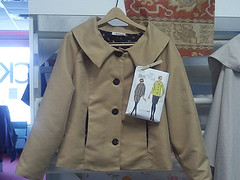
I was looking back at previous posts and I realized that I hadn’t put up a picture of my jacket from 2009. It’s the same pattern as my “Winterized Jacket” . The outer is a poly-cotton blend and the lining is a wool blend.
The buttons down the front are more than decorative. There are tabs that go across. The jacket ended up looking a little “Sgt. Pepper” with them on so I decided to take them off.
The front facing isn’t attached to the lining. One of these days I intend to add an extra lining that zips or buttons to the facing.
It took 2 years from this post to finish said capelet. Then another year to actually write about it.
As previously mentioned… The plan was to cut up a charcoal grey, felted wool circle skirt and make a capelet. I had just enough for the body of the cape but not enough for a collar and facing. Luckily, I had a mountain of cashmere sweaters at my disposal. The plan was to use McCall’s 5764 and modify it to include a lining (why are all of my patterns unlined?)
The key to using cashmere as a collar and facingwas to back it with fusible knit interfacing to make it more stable. The other option would be to felt the cashmere (I only had one grey sweater to work with so I chose interfacing).
The lining was new. I didn’t have anything that worked so I bought a remnant from JoAnn’s. I used frogs for the closure.
Spinsta.net is powered by WordPress.
spinster n.
The word spinster came into common use during the early 19th century when the task of spinning cloth had been pushed onto unmarried women as a way to earn their keep in the home.
Spinsta Spinster
Contemporary use of the word conjures up a mental image of an independent a childless,stylish frumpy, middle-aged woman who is a jet-setting, trendsetter somewhat depressed, and is an inspiration to other women longing to be like other "normal" women.
|